
Cross-Border Communication
This work has been commented by 2 curator(s). Read the comments
Title
Cross-Border Communication
Headline
Hijacking a conversation between two border cities
Concept author(s)
Justin Langlois; Danielle Sabelli; Michelle Soulliere; Joshua Babcock; Cristina Naccarato; Rosina Riccardo
Concept author year(s) of birth
1984, 1985, 1988, 1987, 1988, 1990
Concept author(s) contribution
We work collectively as Broken City Lab. We share all work and credit.
Concept author(s) Country
Canada
Friendly Competition
Love Conflict Imagination (2010-2011)
Competition category
Mobilization
Competition field
academic
Competition subfield
educator/researcher
Subfield description
University of Windsor
Check out the Love Conflict Imagination 2010-2011 outlines of Memefest Friendly competition.
Description of idea
Describe your idea and concept of your work in relation to the festival outlines:
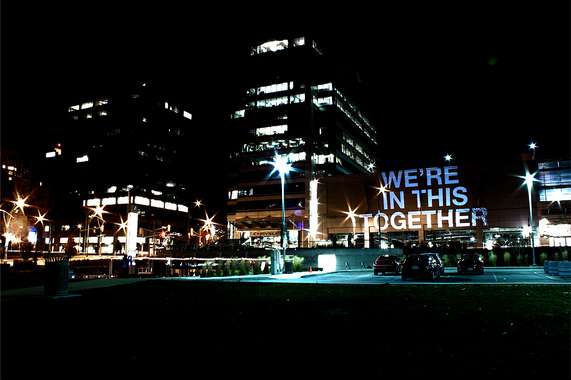
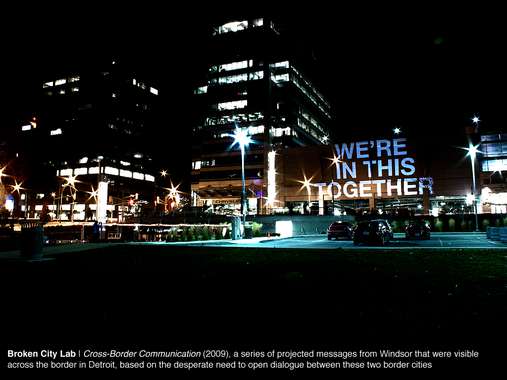
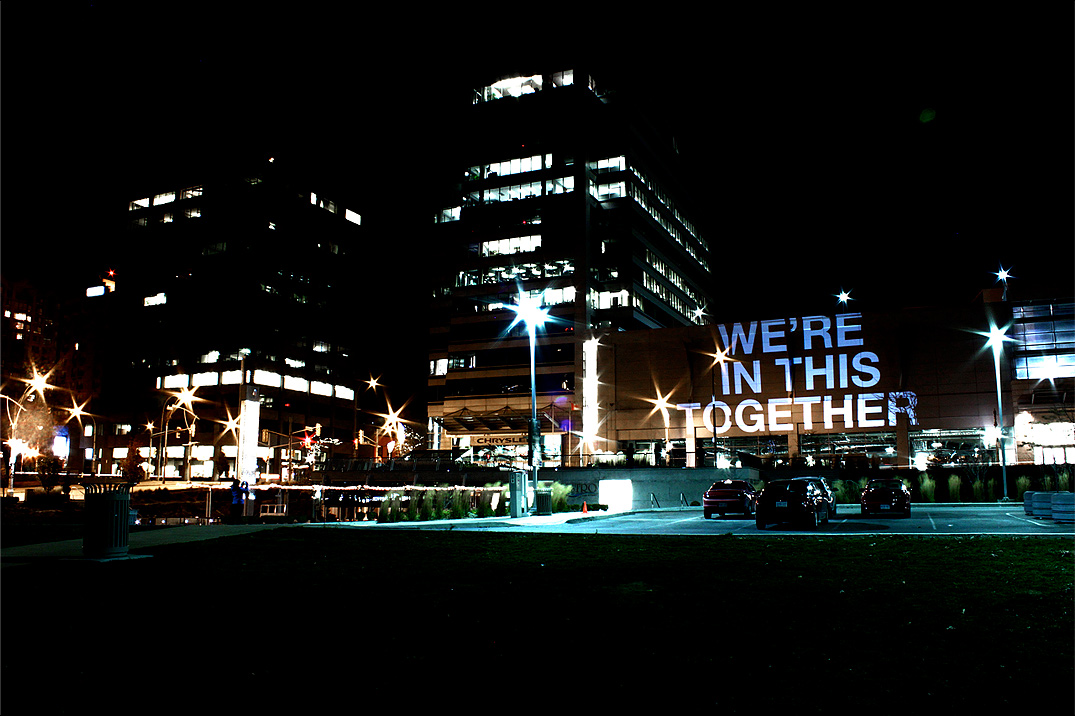
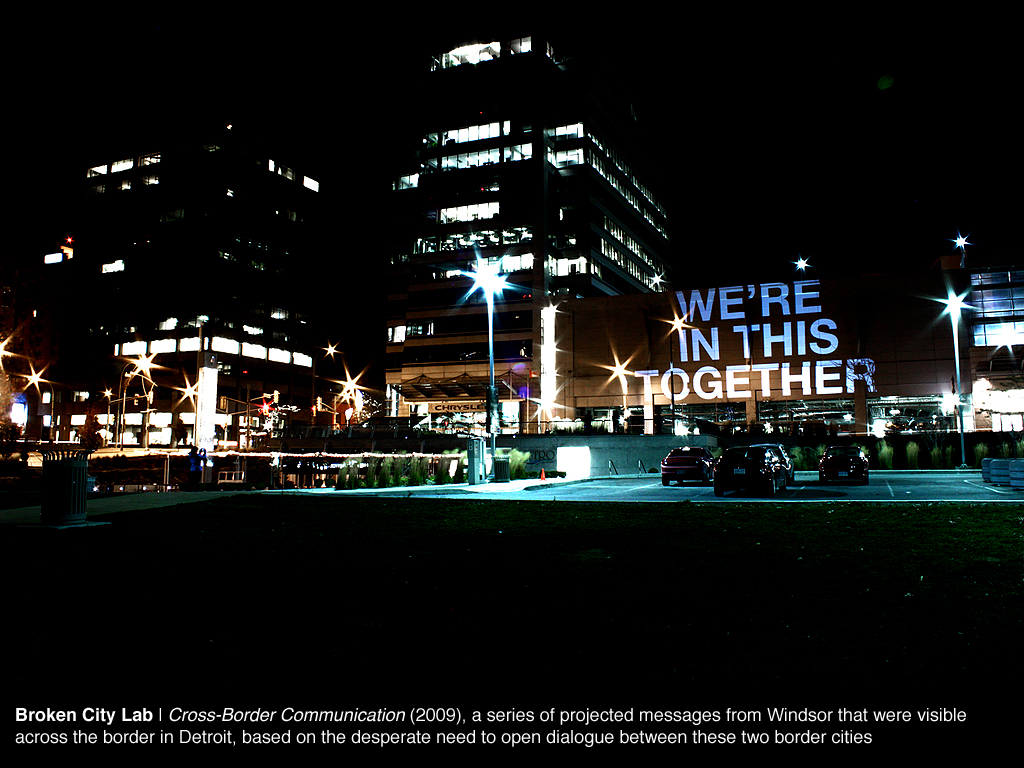
For three nights in November 2009, we projected a series of messages from Windsor, Ontario, Canada that were visible across the border in Detroit, Michigan, US as an interventionist performance series based on the desperate need to start a new conversation between these two cities. We highjacked a conversation between corporations like GM, Chrysler, and Caesars Casino, and government entities like Canadian Customs and Homeland Security. We quietly transformed how we experienced a border, for an hour each night, by projecting short messages culled from our own imaginations and from conversations with our community on buildings on Windsor's waterfront that were visible in downtown Detroit -- "We're In This Together", "We've Missed You", and "We Need to Talk". These messages were imagined to address not only a hopeful future, but to own up to the reality our communities face each day -- staggering unemployment rates, failing industry, and incredibly high vacancy rates -- a reality that we've allowed to happen to ourselves and one that we need to address on our own scale, as a small part of one large community.
What kind of communication approach do you use?
Guerilla Projection with custom software using messages articulated from deeply understanding our community. The project uses the simplest way possible to create text large enough to be visible across and international border.
What are in your opinion concrete benefits to the society because of your communication?
The opening of a new conversation (however quietly) between two communities so physically close, yet so socially far apart. By taking the communication between Windsor and Detroit away from corporations and government agencies, we hope to start a new way of approaching a two-nation community that has been so historically mediated by economic pressures. We are confident there is more to be said and we look forward to helping others to say it.
What did you personally learn from creating your submitted work?
This project was one of the most empowering things that we have done as a collective and it helped to solidify something that we had been feeling for a long time -- a sense that the city is touchable, that deciding to do something and actually following through with it is entirely possible. Standing out in the cold at the edge of the country for a few nights really made us all feel that whether or not anyone was receiving our messages in Detroit, whether or not anyone in Windsor knew we were doing it, that we were taking some ownership over something that is much larger than just us, and that has shaped everything we've done since.
Why is your work, GOOD communication WORK?
Cross-Border Communication altered the conversation that we, as a community, are having with another country for the few nights that we projected messages. We are faced with a border that hinges on economic exchange, with a history of two cities that is built on a failing automotive industry, and yet we seem to be unable to connect at any social level. The project allowed the six of us to send a much different message -- one based not on an failed economic model, but one based on an understanding that we need to stand together to create a liveable community.
Where and how do you intent do implement your work?
This was a 3-night guerilla projection performance that took place at Windsor's waterfront, with large-scale text visible across the Detroit River in Detroit's Hart Plaza. We secured equipment from community organizations and wrote simple custom software that allowed us to change the text in real-time. We connected a projector and laptop to a backup power supply battery and sent messages visible across an international border for an hour each night.
Did your intervention had an effect on other Media. If yes, describe the effect? (Has other media reported on it- how? Were you able to change other media with your work- how?)
Curators Comments
Kevin Yuen-Kit Lo
This is a simple, powerful, poetic and context sensitive project. I very much appreciate that a guerrilla communications approach has produced a work that operates at such a massive (if quiet) scale.
In form it reminds me very much of Jenny Holzer's recent projection series: http://jennyholzer.com/ (without the public art infrastructure). But what sets this apart is how well it relates to its specific geo-political context. The very nature of the project succinctly questions the role of borders, and the other imaginary things that separate us, especially in relationship to these two cities and their related histories.
It would be interesting to see how this project could be extended. On a basic level, a variety of different messages, created from an understanding of the communities' issues, projected from both sides of the border would be very interesting.
Furthermore the development of other tools for the communities to communicate, while maintaining the simplicity and efficacity of this approach, would push this project to another level.
Sandra Rengifo
This series of interventions reflected in various media (print, in chambers as objects, workshops), immediately forwarded a lot of decolonial spirit, as a demonstration embodied in the contemporary critical theory.
Although it doesn't belongs directly to Latin America, its reflection on the border, the frontier, about closeness and distance, about non placement, begins to acquire a strong sense. Nationality, identity and territory are the main lines of this project.
It so articulates as a mechanism to propose other responses before the dominant principles and other knowledge hierarchies. However, it is necessary to multiply this type of actions in other limit-territories.
Networking with new guerrillas in other countries (explore the possibility of having allies that replicate the experience) and keeping the charm of direct feed (as a mechanism inherited from TV), could generate new possibilities witch break borders again.
11 years, 10 months ago