
Plant Exchange
by mur
This work has been commented by 1 curator(s). Read the comments
Title
Plant Exchange
Headline
Concept for community plant exchange station
Concept author(s)
Jukka Liukkonen (Murrr)
Concept author year(s) of birth
1983
Concept author(s) contribution
Full work
Concept author(s) Country
Finland
Friendly Competition
Competition category
Mobilization
Competition field
nonacademic
Competition subfield
artist
Subfield description
As an artist, I do installations. My works are very conceptual, social and they interact with the environment around us. Besides being an artist, I'm also an activist. I take part in the environmental and equality issues in NGOs.
Check out the Debt. 2012 outlines of Memefest Friendly competition.
Description of idea
Describe your idea and concept of your work in relation to the festival outlines:
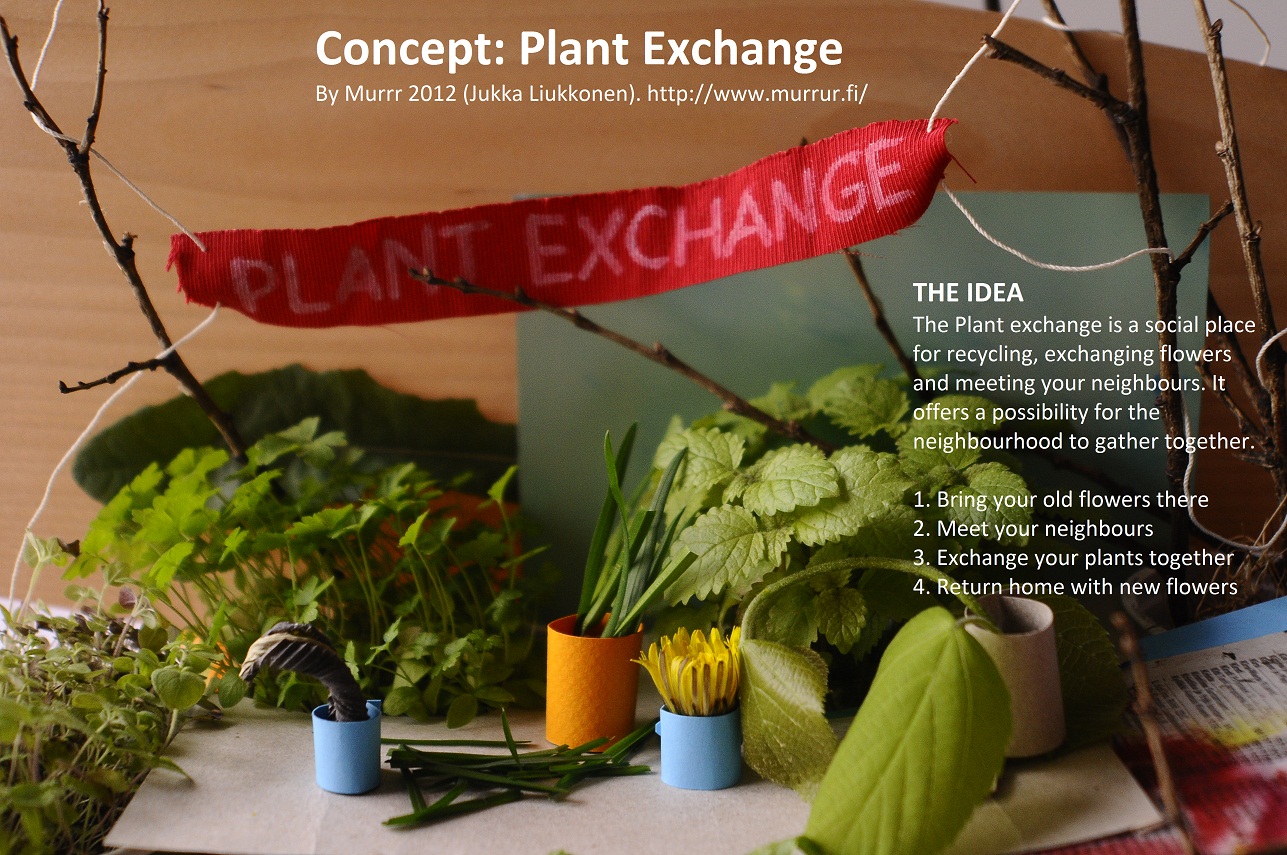
The Plant exchange is a social concept where the community can exchange their home plants, flowers and seeds with their neighbours. The plant exchange is a location that let's neighbours meet each other and share their stories, while it is also a place to store and donate plants. The work is an installation or a concept of a place where local neighbourhood residents and citizens can bring and leave their old plants and choose new house plants for their homes for free of charge.
Basic idea:
1. It is a location where people can come
2. bring your old plants and flowers
3. meet neighbourhood residents at nice place
4. leave with someone else's plant and have new flowers at your home
The work explores the alternative ways of building communities and communications.
(This is actually more like installation or social concept rather than visual project. There wasn't an appropriate category for project that combines the social, activist and artistic aspects together. )
What kind of communication approach do you use?
It is a social concept where the community can participate and create their own space beyond the consumer society and corporate space. The social space and its participatory interaction is based on mutual trust, non-commercial exchange and goodwill.
What are in your opinion concrete benefits to the society because of your communication?
It strengthens the local community, provides alternatives for exchanging goods and provides community a way to meet each other and make each other happy. It changes the focus from production and consumerism to exchange of ideas and do-it-yourself. It change focus from how much does it pay and branding the products to feelings, creativity and building sustainable future and good neighbourhood.
What did you personally learn from creating your submitted work?
I deepened my understanding of social interaction and bio arts.
Why is your work, GOOD communication WORK?
Because it enables the people to do things they were earlier unable to do. It changes world to better place.
Where and how do you intent do implement your work?
The plan would be to set up a plant exchange location and announce it publically in near future. Possibly in cooperation with neighbourhood organizations and citizen movements. I have installed similar biological exchange station in Pixelache festival this year. Exact date and place are yet to be decided.
Did your intervention had an effect on other Media. If yes, describe the effect? (Has other media reported on it- how? Were you able to change other media with your work- how?)
It has had influence on personal life of people and it has given them inspiration.
Curators Comments
Alain Bieber
This project is a great example of real social communication - realized with an artistic approach. It´s a concept people can easily understand and appreciate and participate - without having a big knowledge of art history. It´s accessible and made for and with the people, it´s quite a "quiet" artwork (it do not need to be loud, aggressive and destructive to have an impact) and still it can change a lot. I also like the non-commercial exchange that transforms into a verbal exchange that leads to social interaction. See also "Social Seeds" project in Berlin (http://www.ueber-lebenskunst.org/contents/project_view/nodeId:54) and "Adopt a plant" in England (http://www.adoptaplant.co.uk/).